
Attachment Styles in Texting: Anxious, Avoidant, Secure
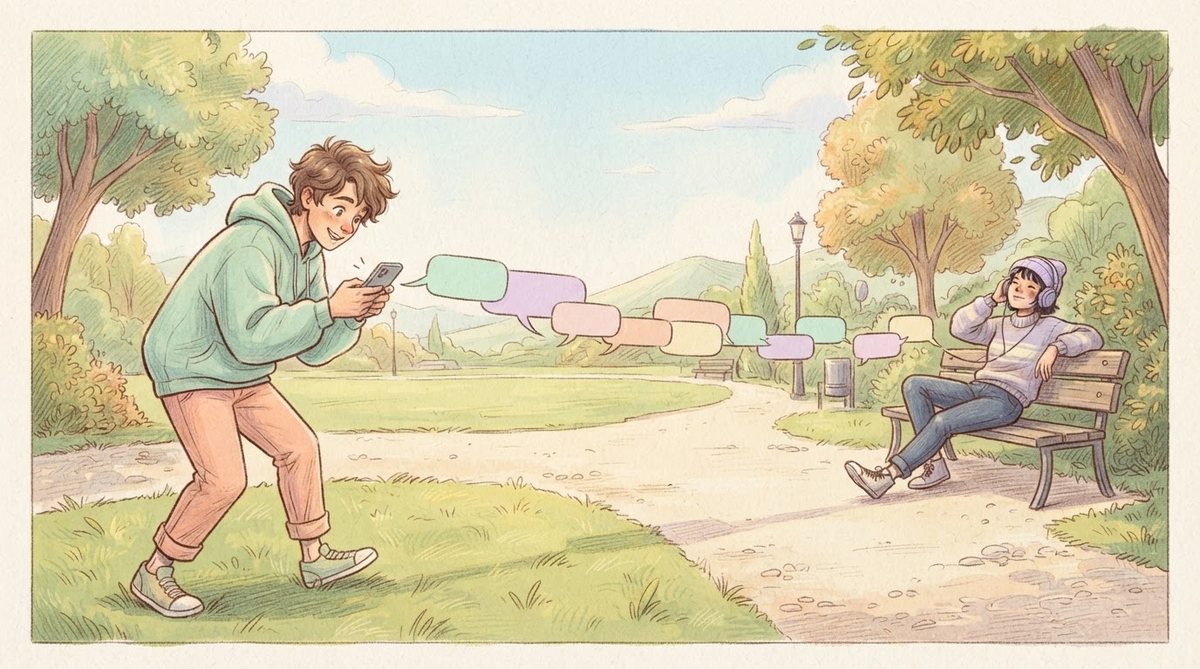
Attachment styles show up in texting as patterns, not single messages. Anxious texting looks like double texts, fast replies and checking in when the other person goes quiet. Avoidant texting looks like slow, short replies, warmth that drops after a close moment and plans left vague. Secure texting looks boring: steady replies, questions both ways and plans that happen. A chat can hint at a style, but it isn't a diagnosis.
Attachment theory describes how people handle closeness: whether they lean in, pull back, or do a bit of both. Texting is a good place to see it, because a chat records every time someone reached out, waited or went quiet.
The styles at a glance
| Style | In a chat it often looks like |
|---|---|
| Secure | Steady reply times, questions both ways, plans with a day attached, conflict talked through |
| Anxious | Double and triple texts, very fast replies, reassurance-seeking, a spiral when the other person is slow |
| Avoidant | Short or late replies, distance after an intimate moment, vague plans, topics changed when things get serious |
| Fearful (disorganized) | Hot and cold: intense closeness, then a sudden pull-back, then back again |
Everyone texts anxiously or avoidantly sometimes. A style is what happens most of the time, especially under stress.
Anxious attachment over text
The anxious texter feels silence as a message. A slow reply starts a story ("they're losing interest"), and the story produces more texts: a follow-up, a joke to restart the chat, an "everything ok?". Replies come fast, because waiting is uncomfortable. The giveaway in a chat is the imbalance: one person starting most conversations and answering in minutes while the other drifts.
Avoidant attachment over text
The avoidant texter keeps a comfortable distance. They can be warm, then cool off right after a moment of real closeness: a long late-night talk followed by two days of one-word replies. Plans stay vague, deep questions get light answers, and texting is often easier for them than calling.
Secure texting looks boring, and that's the point
No games, no long silences after a fight, no guessing. Replies come at a steady pace, questions go both ways, and "let's get dinner" turns into a date. If a chat feels calm, there's a reason. More on what that looks like in green flags in texting.
The anxious-avoidant loop
The most recognizable pattern in a chat is two styles feeding each other. One person reaches for closeness; the other feels the pressure and pulls back; the pull-back makes the first reach harder. In numbers: one side starts most conversations and replies fast, the other replies slower and slower. In words: more questions on one side, shorter answers on the other.
Can AI read attachment style from texts?
Partly, and with care. In a 2018 study, Hiram Calvo trained a model on short autobiographical texts written by 202 people who also filled in an attachment questionnaire; it predicted their style with 64% to 85% accuracy depending on the style (Computación y Sistemas). A 2020 follow-up on short biographies got around 41% at best (Journal of Intelligent & Fuzzy Systems). Those were written texts about people's lives, not chats, and the results swing a lot.
So treat any attachment read from a chat as a hypothesis about how two people behave with each other in that chat. It isn't a personality test, and it can't see the rest of a relationship.
How to see it in your own chat
Look for the behaviors, not the words: who starts conversations, how fast each of you replies, whether that changes after a close moment, whether plans get made. Red Flag: Cringe Chat Analyzer counts the first two from a WhatsApp export and gives an attachment style for each of you as part of the read, alongside the pattern the two of you fall into. See the WhatsApp chat analyzer for what else it reads.
FAQ
Can you tell someone's attachment style from their texts?
You can see hints of it in patterns over weeks: reply times, who reaches out, what happens after closeness. You can't diagnose it from a chat; a questionnaire or a therapist does that better.
How does someone with avoidant attachment text?
Often slowly and briefly, with warmth that drops after a close moment, vague plans and a preference for light topics.
Is double texting a sign of anxious attachment?
Not on its own; plenty of secure people double text. A steady habit of double texting when the other person is slow, together with reassurance-seeking, fits the anxious pattern.
Is there a test for attachment style based on texts?
Not a validated one. Apps can read patterns in a chat and suggest a style, but that's a read of one relationship, not a clinical test.
Stop guessing. Run the chat.
Red flags, interest level, reply times, who texts first — plus an AI image and song of the whole dynamic.